Extreme Restraint

I’m continuing the theme of extreme scenes that started with my last post. This time it’s a scene based purely around restraint and imprisonment – 19 days in a padded cell.

The scene is almost exactly as the title suggests. Meaning there’s no sexual activity, no break to play and no significant human contact. Just a man, a small brightly lit padded cell, some bondage and a lot of time to kill. You can read about it both from the inmate and the warden’s perspective. It’s both impressive and more than a little crazy.

I do understand the appeal. If I ever get the opportunity – meaning the right space and the right play partner – I do think it’d be fun to explore imprisonment scenes. But only for a long weekend, and only if physical play and other human contract was mixed in. I suspect the kind of isolation scene described in the linked articles would drive me insane within a week.

Art is by coco.

Pulpy Goodness

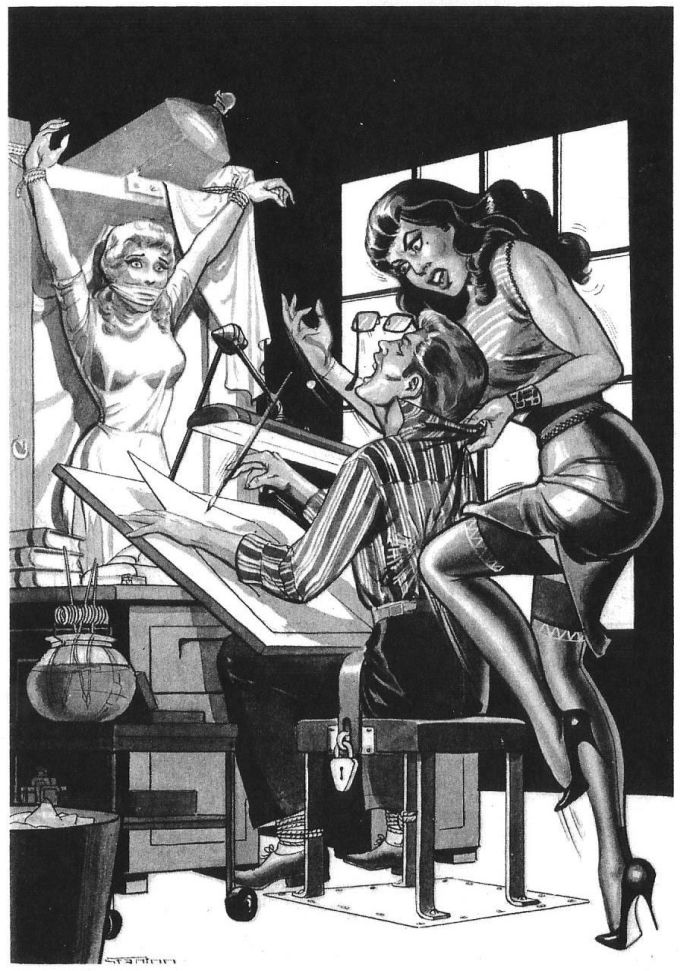
I always enjoy this kind of pulpy cover art from the 50’s and 60’s. It was an era where mainstream media was incredibly straight and conservative, at least compared to the media of today. And yet, the pulp magazine publishers apparently discovered the cheat code for using kinky sex to sell magazines in mainstream stores.

I also like the fact that femdom scenes were featured so frequently. I’m sure there’s a bunch of theories about why that was. They probably focus on their violation of cultural norms, given the patriarchal and conformist nature of the society at the time. I like to think it was because publishers like money and lots of men like femdom content.

I sourced this via Femdom Days Twitter feed.

Ada

As regular readers may know, I occasionally like to feature women who weren’t sexually dominant (as far as we know) but were amazing and impactful historical figures. For example, a couple of past examples include Julie d’Aubigny and Beryl Swain.

Today, inspired by this article on the Blue Stocking site, I’m featuring another – Ada Lovelace. Given I’ve spent a large part of my life writing software, she’s a figure near and dear to my heart. Her notes on Charles Babbage’s Analytical Engine are the first example of what we think of today as computer programming. They pre-date the work of the equally brilliant Alan Turing by 100 years. From this article

She then summarises how a sequence of computations would work on the Analytical Engine; with “Operation Cards” to define the operations to be calculated, and “Variable Cards” to define the locations of values. Lovelace discusses “cycles” and “cycles of cycles, etc”, known to contemporary programmers as loops and nested loops. She gives a mathematical notation for them, which comprises the first instance of a recorded software loop.

She then moves on to Note A, wherein she portrays an extraordinary concept of a general-purpose computing machine– a simply unparalleled vision.

Sadly, she died young, aged just 36. Babbage’s analytical engine was never built and history had to wait until the 1940’s and 1950’s for computer programming to return. That historical gap presents an interesting ‘what if’ moment that fiction authors have enjoyed filling.

There is a programming language named after Ada , although it’s sadly not a widespread one these days. That’s a shame, as I’d much prefer writing in something called Ada rather than the unimaginatively named variations of ‘C’ that are now common.

Image of Ada Lovelace as featured in this article on her in the New Yorker.

Dreaming

From a modern artist in my last post to a vintage one in this. The artist here is Bernard Montorgueil, whose work dates back to the 1930’s.

I think this is lovely idea for a drawing. You have the sleeping man and his dream, a beautifully attired but translucent domme riding his naked body. This was a new image to me, which seems kind of odd for an artist whose work is almost 100 years old. It’s nice to discover something new in something old.

You can find this and others at the Honest Erotica site.

Ineffective but Fun

A little humor here from the War and Peas comic. The jellyfish thing is sadly a myth. So if you want to get peed on – and I’m definitely a fan of that – you’ll need another excuse. Maybe we can start a rumor it’s the perfect cure for a headache? Or stubbed toes? I’m always bashing mine and I’m sure a quick golden shower would take the edge right off.
You can find more from War and Peas on Bluesky and on their Patreon.

Nice Units

Kicking off the weekend with a touch of humor. This is from Luck of the Draw Comics. The imperial system of measurement being designed by someone focused on satisfying their kinks would explain a lot about it. Although having said that, the meter was defined as “one ten-millionth of the shortest distance from the North Pole to the equator passing through Paris, assuming an Earth flattening of ⁠1/334⁠”. Which seems an even stupider way of picking a standard length than basing it on your favorite sexy body part.

You can find more from Luck of the Draw on Reddit and Bluesky. They also have a book out.

Evil Sophia

Here’s a new (to this blog) artist to check out – SerTheCatKnight. He’s a French BDSM artist. His work covers a mix of kinks and couplings, but there’s a lot of nice Femdom or Femdom adjacent material in there.

I was actually tempted to post this image for Valentine’s day. After all, what could be more romantic than a night in chastity watching your partner fuck someone else? It’s just what cupid would have wanted.

SerTheCatKnight has a Deviant Art account here. I can’t see a social media account for them anywhere.

Banging Heads

Here’s Wonder Woman fulfilling a common fantasy – cracking some political heads together. I’m sure we’ve all dreamed of doing this. Particularly with the current bunch of criminals in power.

The artist is H. G. Peter. He’s credited as the co-creator of Wonder Woman, alongside William Marston. Having just looked up his details, I was astonished to learn he was born in 1880. I know Wonder Woman is from the Golden Age of comics, but it still feels relatively modern. Yet its creator was born in the Victorian era and was already 34 by the time World War I started!